Why Great Leadership Development Starts with the Leader, Not the Coaching Model
How Executive Leaders and Leadership Development Professionals Choose the Right Approach to Develop People and Improve Organizational Performance
Doug D. Knuth, MBA, MSA Certified Executive Leadership Coach | Doctoral Candidate in Strategic Leadership
Leadership Development Is About Judgment, Not Just Methodology
Throughout my career as a university executive, I spent hundreds of hours in conversations that shaped careers, influenced organizational culture, and ultimately affected institutional performance. Some discussions centered on accountability and execution. Other leaders required help in navigating ambiguity, organizational politics, organizational change, or difficult personnel decisions. Still others involved helping high-performing individuals recognize leadership blind spots that were limiting their effectiveness. All situations were different.
At the time, I didn't think of those conversations as executive coaching. I simply viewed them as part of leadership.
What I understood instinctively was that every leader required something different. The same approach rarely worked twice because every leadership challenge existed within a unique organizational context.
Years later, after becoming a Certified Executive Leadership Coach and pursuing doctoral research in Strategic Leadership, I discovered something both validating and transformative. No single coaching model had ever seemed sufficient.
The most effective leadership development professionals do not begin with a preferred coaching model. They begin with the leader.
They seek to understand the organizational context, the leadership challenge, the desired outcomes, and only then determine which developmental approach is most likely to accelerate both individual and organizational success.
That realization fundamentally changed my philosophy of leadership development.
Leadership Development Is Bigger Than Executive Coaching
Organizations invest billions of dollars annually in leadership development because leadership quality directly influences organizational performance. Strong leadership affects employee engagement, innovation, organizational culture, succession planning, decision making, and ultimately strategic execution.
Executive coaching has become one of the most valuable leadership development interventions because it provides individualized development tailored to a leader's unique circumstances. Yet coaching should never be viewed as an isolated solution. It is one component of a broader leadership development strategy that also includes mentoring, assessment, stretch assignments, feedback, experiential learning, and formal education.
This distinction matters. Organizations are not purchasing coaching conversations. They are investing in leadership capability.
The goal is not simply to help executives solve today's problems. It is developing leaders who possess the judgment, adaptability, self-awareness, and strategic thinking necessary to succeed in increasingly complex environments.
That perspective shifts an important question. Instead of asking, "Which coaching model is best?", we should ask, "Which developmental approach best serves this leader, within this organization, at this moment?"**
What My Research Changed
As part of my doctoral studies, I studied four respected coaching approaches:
GROW
TOMS
Active Inquiry
Co-Active Coaching Initially
I expected to discover which model produced the best coaching outcomes. Instead, I reached a different conclusion. Each model reflects different assumptions about how adults learn, how leaders develop, and how meaningful change occurs.
None is universally superior. Each is exceptionally valuable when applied within the appropriate context.
That insight mirrors what I had experienced as an executive. Leadership challenges rarely exist in isolation. They emerge from the interplay among individual capabilities, organizational culture, interpersonal relationships, strategic priorities, and external pressures. Effective leadership development, therefore, requires both evidence-based practice and thoughtful judgment.
The coach's expertise lies not in rigidly following one model but in selecting, adapting, and integrating approaches that align with the leader's developmental needs and the organization's objectives.
Coaching Models Reflect Different Leadership Development Philosophies
Rather than viewing coaching models as competing methodologies, I have come to view them as complementary perspectives on leadership development.
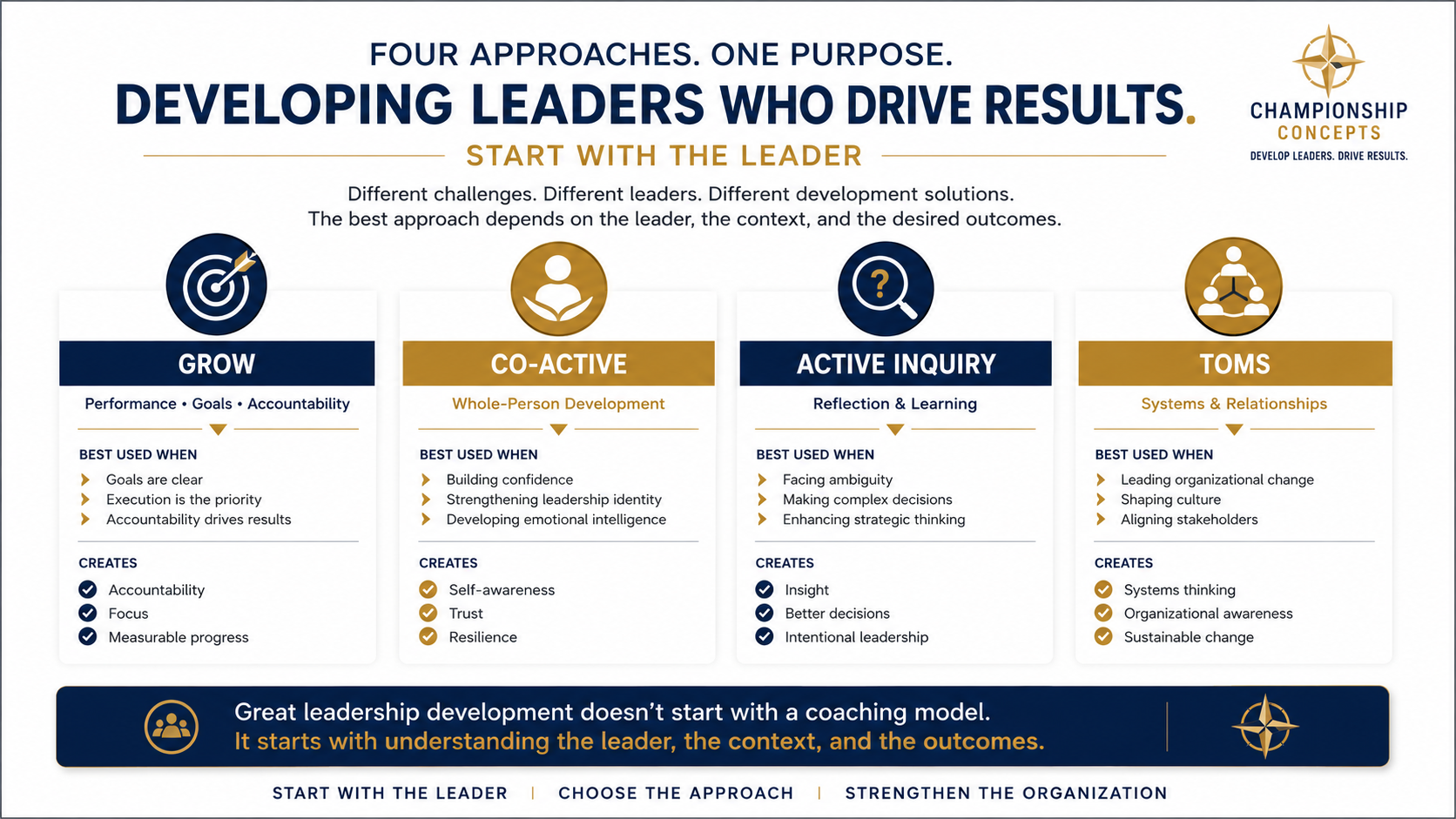
Perspectives on Leadership Development
What becomes apparent is that these models differ less in quality than in purpose.
GROW assumes that progress is accelerated through structured goal attainment and accountability.
Co-Active Coaching begins with the belief that people are naturally creative, resourceful, and capable of generating their own solutions.
Active Inquiry emphasizes reflective learning and intentional questioning.
TOMS recognizes that leadership effectiveness is inseparable from the systems and relationships in which leaders operate.
Each perspective contributes something valuable.
The challenge is knowing when each is most appropriate.
The Executive Coach's Greatest Skill Is Judgment
This is where I believe executive experience and coaching scholarship intersect. An experienced leadership development professional does not simply ask,
*"Which coaching model do I prefer?" Instead, the questions become much more strategic.
*What leadership capability needs to be developed?
*What organizational outcomes matter most?
*Is this primarily a performance issue, a relationship issue, an identity issue, or a systems issue?
* What developmental approach is most likely to produce sustainable improvement?
Those questions require judgment. That judgment develops through a combination of leadership experience, coaching expertise, and continuous learning.
In my own executive career, I often found myself shifting between approaches without realizing it. One conversation required accountability. Another demanded empathy and reflection. A third required helping a leader understand how his or her decisions affected the broader organization.
My doctoral research did not replace those experiences. It provided a framework for understanding why different conversations produced different outcomes.
Leadership Development is Contextual
One lesson has become increasingly clear throughout both my executive experience and doctoral research:
*Leadership is contextual.
The competencies that make someone successful in one role may be insufficient in another. Likewise, the coaching approach that helps one executive thrive may prove ineffective for another. Leadership development professionals, therefore, have a responsibility to diagnose before they prescribe.
That diagnosis should consider:
*the leader's developmental needs,
*the complexity of the leadership challenge,
*the organizational culture,
*the strategic priorities of the organization,
* and the outcomes leadership development is intended to achieve.
Only then should the coaching approach be selected. This is why I believe exceptional coaching begins long before the first coaching question is asked.
It begins with a thoughtful assessment. --- www.dougdknuth.com
My Philosophy of Leadership Development
Looking back on the leadership conversations throughout my executive career, I realize I was never searching for the perfect coaching model. I was trying to help people become more effective leaders who could strengthen their teams, improve organizational performance, and navigate increasingly complex challenges.
Today, I can explain that work more clearly than I could years ago. Executive experience taught me that leadership development is contextual. Doctoral research helped me understand why. Together, they have shaped a philosophy that continues to guide my work with leaders and organizations.
Leadership development does not begin by selecting a coaching methodology. It begins by understanding the leader. It expands by understanding the organizational context. It succeeds by choosing the developmental approach that best aligns with both.
Whether that approach draws from GROW, Co-Active Coaching, Active Inquiry, TOMS, or another evidence-based framework is ultimately a secondary consideration. Coaching models are valuable because they provide structure, perspective, and discipline. They are not the destination.
The destination is stronger leadership.
For leadership development professionals, the greatest expertise is not mastering a single coaching model—it is developing the judgment to know which approach will help a particular leader create the greatest impact for the people and the organization they serve.
That is the philosophy that has emerged from my executive leadership experience, my coaching practice, and my doctoral research. It is also the philosophy I will continue to bring to every organization, every leader, and every conversation focused on building stronger leaders and stronger organizations.
Selected References
Boyatzis, R. E., Smith, M. L., & Van Oosten, E. (2019). Helping people change: Coaching with compassion for lifelong learning and growth. Harvard Business Review Press.
Grant, A. M. (2017). The third 'generation' of workplace coaching. Coaching: An International Journal of Theory, Research and Practice, 10(1), 37–53.
Kimsey-House, H., Kimsey-House, K., Sandahl, P., & Whitworth, L. (2018). Co-Active coaching (4th ed.). Nicholas Brealey.
Kegan, R., & Lahey, L. L. (2009). Immunity to change. Harvard Business Press.
Passmore, J. (Ed.). (2021). The Wiley-Blackwell handbook of the psychology of coaching and mentoring (2nd ed.). Wiley.
Schein, E. H. (2013). Humble inquiry: The gentle art of asking instead of telling. Berrett Koehler.
Thornton, C. (2023). Group and team coaching. Routledge.
Whitmore, J. (2017). Coaching for performance (5th ed.). Nicholas Brealey.
Williams, P., & Menendez, D. (2023). Becoming a professional life coach: The art and science of a whole-person approach (2nd ed.). W. W. Norton & Company.
Yukl, G. (2020). Leadership in organizations (9th ed.). Pearson.
